
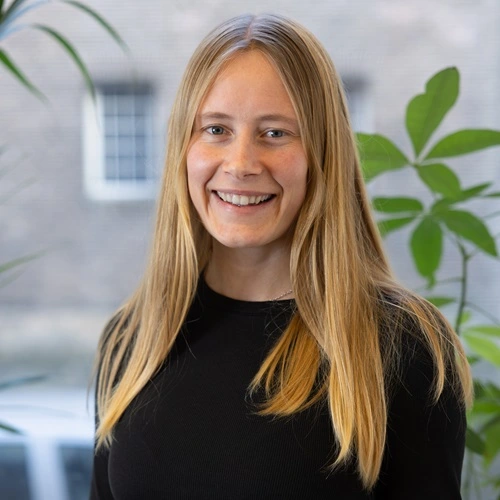
Kayleigh Gultig
Title
Smartphone-based neurometric evaluations: A scalable approach to neurodevelopmental diagnostics
Abstract
Neurometric assays of brain function can reveal fundamental mechanisms underlying neuropsychiatric conditions. Typically, they require centrally located equipment in a laboratory test facility and as a result these tests are often unpleasant for participants as they require instruments attached to their face and cannot be used at scale in daily clinical practice.
Recently, we have developed a smartphone-based software platform, termed BlinkLab, to perform neurobehavioral testing free from facial instruments or other fixed-location equipment. This AI platform is designed to be used at home or in similar environments, independently or with the assistance of a caregiver, while following instructions from the mobile-device application.
The tests include, but are not limited to, eyeblink conditioning, a form of sensory-motor associative learning, prepulse inhibition of the acoustic startle response, which measures the ability to filter out irrelevant information through sensorimotor gating, and startle habituation, which measures the ability for the intrinsic damping of repetitive stimuli. In my seminar, I will show that our new approach provides a scalable, universal resource for quantitative assays of central nervous system function to improve the diagnostic evaluation process for neurodevelopmental conditions such as autism.
Biography
Kayleigh Gultig obtained her master’s degree in Neurosciences from Vrije University, Amsterdam and is currently a PhD student at the Department of Neuroscience, Erasmus University Medical Centre in Rotterdam and a researcher at BlinkLab. Her PhD research focuses on the use of smartphone-based neurometric tests for diagnostics and intervention monitoring in children with neurodevelopmental conditions.
She started as a researcher at BlinkLab in 2022 where she did her master’s thesis on the effects of acute aerobic exercise on associative learning. At BlinkLab she is involved in clinical projects focusing on autism and ADHD. She also leads collaborations with external partners to investigate neuropsychiatric conditions like schizophrenia, rare disorders such as SHANK2, and neurodegenerative diseases, including various forms of spinocerebellar ataxia.